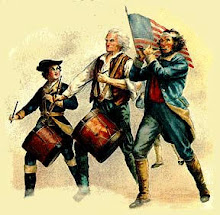
Last week, I finished reading American Lion by Jon Meacham. It is a colorful and enlightening read about a fascinating man. Rather than piling on minute biographical details, Meacham strives to present Jackson's life and doings in broader terms. His book is just as concerned with American politics during the 1830s and 1840s as it is with Jackson's personal doings.
President Jackson, the sixth of our nation's chief executives, was a strange blend of southern gentleman, warlord, kindly grandfather, and violent sociopath. When he wasn't literally playing Santa Claus at Christmas, bringing bundles of presents to D.C.'s orphans, he was horsewhipping his political foes and purging the southern states of their Native American inhabitants. With one hand, he drove the Native Americans on to a western death march; with the other, he chastised big bankers in the name of making America a better place for the downtrodden.
If you consider Jackson the first modern Democratic president (I use that term loosely here), a fascinating progression can be seen. Jackson was a big-government, federally-minded ruler, who expanded executive control over the country and sought to put capitalist "fat cats" into place. His dismantling of the National Bank is an eerie forerunner to the meddlesome regulatory ways of President Obama. However, Jackson was more politically incorrect than mostly any other president in the nation's history. His Indian removals are the fodder of public school moralizing (rightfully so). He saw absolutely no value in racial equality, and considered abolitionists a danger to the country.
In addition, he believed firmly in the use of violence and force to bend and break his opponents, be they tribal, international, or personal. If Jackson didn't like you, he might just shoot you, horsewhip you, or challenge you to a duel. As an army general, he even carried out unauthorized military actions against foreign powers (imagine if General McChrystal marched into Iran and destroyed the place without consulting the White House first). The tenderness of Jackson's domestic life is almost silly in its polar opposition to his public persona.
No doubt he was a complicated man. In my opinion, he is too complicated for the age of the soundbite. That is why Meacham's book is so fascinating: ultimately, we don't know what to do with President Jackson. Progressive politics have marched so far beyond anything he could have imagined that his own Democratic successors are afraid to even mention him.
Politicians today will cite Lincoln, Washington, Jefferson, Reagan, and FDR as they try to position themselves. No one ever mentions Jackson. Libraries, colleges, and streets are named after the aforementioned, but far fewer landmarks and roadsigns bear the sixth president's name.
It is not for lack of importance that we leave him out of the presidential superstar club. In particular, Jackson left an indelible mark on the character of the executive office (one that subsequent presidents did not live up to; nobody remembers Martin Van Burn, John Tyler, or James Buchanan precisely because their vision of the presidency was less proactive than Jackson's). His use of the veto was hugely controversial in a time when American presidents were expected to let Congress do the lion's share of the governing.
Rather, it is the discomfort of his legacy that leaves Jackson on the back burner. Jackson was not unlike Obama, in that his basic governing philosophy called for massive federalization with anti-capitalist rhetoric. But you will never see Obama refer to himself as "a member of the party of Jackson". The racial and personal issues surrounding Jackson are too insurmountable.
What would Jackson think of the Democrats of today? He might be vaguely impressed with their social programming. He would also think that they were a pack of wimps, and it is not a stretch to imagine him firing pistols at them.
Showing posts with label American Presidency. Show all posts
Showing posts with label American Presidency. Show all posts
Thursday, March 25, 2010


Thursday, January 28, 2010
State of the Union Post-Game Thoughts
For sheer exhaustion and sheer lack of interest in hearing truthless partisan rhetoric, I cannot claim that I have delved into President Obama's State of the Union address enough to give an "analysis" of its every in and out. However, I have seen enough of it (and have read enough of the transcript) to give a low-down.
Here are some thoughts on Obama's address:
Joe Biden nodded with approval at everything Obama said, with a stern sort of smile on his face. Nancy Pelosi looked more squirmy and frowny. That spanking that her healthcare bill took must still be fresh in her mind.
A word on demeanor: thankfully, he didn't use that damned shouting lilt that emerged at certain town meetings.
"Bad work on Wall Street is rewarded, while hard work on Main Street isn't." Well, Mr. President, who was doing the rewarding?
Cries against bipartisanship? A need for Republicans to do more than "say no"? Seeing as how the Obama White House and the Pelosi Congress have effectively shut the GOP out of the healthcare reform process, this comes off as unstudied hypocrisy. It is all too easy to point out the speck in others' eyes without acknowledging one's own plank.
There was much talk of "the people". The dreams of the people, the stubborn resilience of the people, the hopes of the people. I get queasy whenever any politician resorts to lofty generalities about "the people". It smells of overripe Latin American populism (and yes, some Republicans are guilty of this too). It also seems a tad desperate.
"From some on the right, I expect we’ll hear...that if we just make fewer investments in our people, extend tax cuts for wealthier Americans, eliminate more regulations, and maintain the status quo on healthcare, our deficits will go away. The problem is, that’s what we did for eight years. That’s what helped lead us into this crisis. It’s what helped lead to these deficits. And we cannot do it again." It seems that Obama has a pathological need to blame George W. Bush for almost every single problem his own presidency has run into. In a State of the Union address, a solemn and typically dignified occasion, this cheap trickery is particularly disgusting and unwelcome.
Finally: Obama's criticism of the Supreme Court for its campaign finance decision was awkward. Now, conservatives need to be fair here. I'm no fan of the Supreme Court's unchecked power and its arrogant assertion of its own opinions as law (see Roe vs. Wade). If a president blasted the Supreme Court for that particular decision, I would be applauding. However, given that Obama was blasting the Court for a ruling that I agree with, I was disappointed. The real question is whether or not such political posturing ought to be occurring at such a solemn and (ideally) non-partisan occasion? If Obama had been more discreet, more veiled, less open, would the idea he expressed have been more acceptable?
Here are some thoughts on Obama's address:
Joe Biden nodded with approval at everything Obama said, with a stern sort of smile on his face. Nancy Pelosi looked more squirmy and frowny. That spanking that her healthcare bill took must still be fresh in her mind.
A word on demeanor: thankfully, he didn't use that damned shouting lilt that emerged at certain town meetings.
"Bad work on Wall Street is rewarded, while hard work on Main Street isn't." Well, Mr. President, who was doing the rewarding?
Cries against bipartisanship? A need for Republicans to do more than "say no"? Seeing as how the Obama White House and the Pelosi Congress have effectively shut the GOP out of the healthcare reform process, this comes off as unstudied hypocrisy. It is all too easy to point out the speck in others' eyes without acknowledging one's own plank.
There was much talk of "the people". The dreams of the people, the stubborn resilience of the people, the hopes of the people. I get queasy whenever any politician resorts to lofty generalities about "the people". It smells of overripe Latin American populism (and yes, some Republicans are guilty of this too). It also seems a tad desperate.
"From some on the right, I expect we’ll hear...that if we just make fewer investments in our people, extend tax cuts for wealthier Americans, eliminate more regulations, and maintain the status quo on healthcare, our deficits will go away. The problem is, that’s what we did for eight years. That’s what helped lead us into this crisis. It’s what helped lead to these deficits. And we cannot do it again." It seems that Obama has a pathological need to blame George W. Bush for almost every single problem his own presidency has run into. In a State of the Union address, a solemn and typically dignified occasion, this cheap trickery is particularly disgusting and unwelcome.
Finally: Obama's criticism of the Supreme Court for its campaign finance decision was awkward. Now, conservatives need to be fair here. I'm no fan of the Supreme Court's unchecked power and its arrogant assertion of its own opinions as law (see Roe vs. Wade). If a president blasted the Supreme Court for that particular decision, I would be applauding. However, given that Obama was blasting the Court for a ruling that I agree with, I was disappointed. The real question is whether or not such political posturing ought to be occurring at such a solemn and (ideally) non-partisan occasion? If Obama had been more discreet, more veiled, less open, would the idea he expressed have been more acceptable?
Wednesday, January 27, 2010
President Obama's State of the Union Address
As the President of the United States prepares to deliver the annual State of the Union address, I can only ask one question: what can he say? What has he done during the first year of his presidency to alter the union's prospects for the better? What can he point to as he stands before the entire country and attempts to justify his first year as our leader?
In light of diving poll numbers, State Senator Scott Brown's bill-killing victory in the Massachusetts senate race, and the basic failure of "Obamaism" in terms of claiming legislative victories, there is not much material to draw from.
The massive spending/stimulus packages? Utterly ineffective.
Obama's decision to send reinforcements to Afghanistan? Right, perhaps, but late.
Obama's healthcare bill? Dead in the water.
Obama's attempts to campaign for Democratic candidates around the country? 0 for 3.
Unemployment? Higher than it was a year ago.
Lay-offs? Steadily streaming.
Hence, there is not much good news to share. Most are expecting a fundamentally reactive presentation. Now is not the time for Obama to jog onstage and arrogantly reassert the failed healthcare reform initiative that he pushed in 2009. Now is not the time for him to set his chin angrily and raise his voice into that telltale shout that he uses when he wants to "talk tough" about his agenda. When you're being hammered by your constituents, and when your cheerleaders in the press can barely conceal the public's anger, you must give an inch or two. Is it not a bad sign for Obama that he's already publicly mulling over the ramifications of losing in 2012?
Look for Obama to reach for some middle ground, hawking his policy goals with renewed rhetorical vigor while simultaneously acknowledging the brick walls.
In light of diving poll numbers, State Senator Scott Brown's bill-killing victory in the Massachusetts senate race, and the basic failure of "Obamaism" in terms of claiming legislative victories, there is not much material to draw from.
The massive spending/stimulus packages? Utterly ineffective.
Obama's decision to send reinforcements to Afghanistan? Right, perhaps, but late.
Obama's healthcare bill? Dead in the water.
Obama's attempts to campaign for Democratic candidates around the country? 0 for 3.
Unemployment? Higher than it was a year ago.
Lay-offs? Steadily streaming.
Hence, there is not much good news to share. Most are expecting a fundamentally reactive presentation. Now is not the time for Obama to jog onstage and arrogantly reassert the failed healthcare reform initiative that he pushed in 2009. Now is not the time for him to set his chin angrily and raise his voice into that telltale shout that he uses when he wants to "talk tough" about his agenda. When you're being hammered by your constituents, and when your cheerleaders in the press can barely conceal the public's anger, you must give an inch or two. Is it not a bad sign for Obama that he's already publicly mulling over the ramifications of losing in 2012?
Look for Obama to reach for some middle ground, hawking his policy goals with renewed rhetorical vigor while simultaneously acknowledging the brick walls.
Sunday, January 17, 2010
Obama's Last-Minute Trip to Boston
Again, I return to the subject of the pending Massachusetts election. At this point it has become a national story. The intensity was ratcheted up today by President Obama's last-minute, emergency trip to Boston, where he stumped for Coakley after spending a couple of weeks saying that he had no plans to do so.
Obama's visit is indicative of the Democrat's utter terror at the prospect of losing. Earlier this week, one poll showed that Brown was not only alive and well, but leading the race. This made Coakley's shy, non-campaigning, and her increasingly negative tone, seem ever more inappropriate; you can't project complacency and arrogance when you're losing. Hence Obama came to invigorate her lackluster campaign with some liberal, hope-and-change magic.
Needless to say, the president is worried about Brown's ability to kill the healthcare reform bill that is currently being rammed down our throats. It's highly unlikely that he would have flown to Massachusetts if the bill was already a done deal. Obama's visit is yet another example of his White House's constant "campaign mode" method of dealing with public policy challenges.
If Brown wins, Obama will have spent political capital on a high-profile, losing battle. Surely, a Brown victory will be seen as a repudiation of Obama's presidency. This is Massachusetts. It is the most liberal state in the union. A Republican victory here would be a clear sign that liberalism is not as embraced in America as its proponents want everyone to think.
P.S.- Is it not delightful that the vile blob of uselessness known as Representative Barney Frank (D-Newton) is already trying to distance the Democratic establishment from Coakley, should she lose?
P.S.S.- Senator Chuck Schumer is an asshole. His crude, politically-irrelevant cutdown of Scott Brown leaves me unable to call him anything else.
Obama's visit is indicative of the Democrat's utter terror at the prospect of losing. Earlier this week, one poll showed that Brown was not only alive and well, but leading the race. This made Coakley's shy, non-campaigning, and her increasingly negative tone, seem ever more inappropriate; you can't project complacency and arrogance when you're losing. Hence Obama came to invigorate her lackluster campaign with some liberal, hope-and-change magic.
Needless to say, the president is worried about Brown's ability to kill the healthcare reform bill that is currently being rammed down our throats. It's highly unlikely that he would have flown to Massachusetts if the bill was already a done deal. Obama's visit is yet another example of his White House's constant "campaign mode" method of dealing with public policy challenges.
If Brown wins, Obama will have spent political capital on a high-profile, losing battle. Surely, a Brown victory will be seen as a repudiation of Obama's presidency. This is Massachusetts. It is the most liberal state in the union. A Republican victory here would be a clear sign that liberalism is not as embraced in America as its proponents want everyone to think.
P.S.- Is it not delightful that the vile blob of uselessness known as Representative Barney Frank (D-Newton) is already trying to distance the Democratic establishment from Coakley, should she lose?
P.S.S.- Senator Chuck Schumer is an asshole. His crude, politically-irrelevant cutdown of Scott Brown leaves me unable to call him anything else.
Saturday, January 9, 2010
Reid's Obama Gaffe Is Telling Indeed
Yesterday, Senator Harry Reid (D-Nevada), the Senate Majority Leader and the White House's healthcare reform lackey, apologized for racially insensitive comments that he made during the 2008 presidential campaign season. The apology was prompted by the fact that Reid's quotes will be appearing in Mark Halperin and John Heileman's new book Game Change, which will detail the 2008 campaign. The crux of the controversy is that Reid apparently referred to then-Senator Obama as a "light-skinned" African-American "with no negro dialect-unless he wants to have one", and remarked that the country would accept such a candidate with ease.
From what I have read, Reid's statements about Obama being "light-skinned" and lacking "a negro dialect" seem to be drawing the most heat from the media. I find the context of the remarks even more disturbing, though.
Remember that Reid was assessing Obama's strength as a candidate when he made these remarks. That he felt the need to appraise Obama's lack of darker skin and his caucasian speaking voice as positive selling points for the Democratic Party is telling. It would seem that at the highest levels, the Democrats were indeed conscious of Obama's viability in regards to the race card. Reid apparently saw potential in Obama's lack of typical African-American features; had Obama been a "blacker" candidate, would Reid have been more ambivalent? What if Obama had featured what Reid called "a negro dialect"? Apparently, the Democrats (or at least their Majority Leader) want their candidates to be diverse, but only to a point. They claim to be the party of tolerance, but African-Americans with "a negro dialect" need not apply.
Being white, I can't speak for African-Americans on how they feel about this. I would guess, however, that many of them are insulted, and I cannot blame them.
P.S. Yes, I know, Reid apologized. Politically-motivated apologies, spurred only by the fact that the initial offense is becoming public, do not impress me.
P.S.S. Reid's chances of re-election are not promising. I look forward to the embarassment that the healthcare reformists will face when half of them are given a beatdown at the polls when the time comes.
P.S.S.S. If Reid runs for re-election, I am willing to bet that ACORN will stage a coup in Nevada.
From what I have read, Reid's statements about Obama being "light-skinned" and lacking "a negro dialect" seem to be drawing the most heat from the media. I find the context of the remarks even more disturbing, though.
Remember that Reid was assessing Obama's strength as a candidate when he made these remarks. That he felt the need to appraise Obama's lack of darker skin and his caucasian speaking voice as positive selling points for the Democratic Party is telling. It would seem that at the highest levels, the Democrats were indeed conscious of Obama's viability in regards to the race card. Reid apparently saw potential in Obama's lack of typical African-American features; had Obama been a "blacker" candidate, would Reid have been more ambivalent? What if Obama had featured what Reid called "a negro dialect"? Apparently, the Democrats (or at least their Majority Leader) want their candidates to be diverse, but only to a point. They claim to be the party of tolerance, but African-Americans with "a negro dialect" need not apply.
Being white, I can't speak for African-Americans on how they feel about this. I would guess, however, that many of them are insulted, and I cannot blame them.
P.S. Yes, I know, Reid apologized. Politically-motivated apologies, spurred only by the fact that the initial offense is becoming public, do not impress me.
P.S.S. Reid's chances of re-election are not promising. I look forward to the embarassment that the healthcare reformists will face when half of them are given a beatdown at the polls when the time comes.
P.S.S.S. If Reid runs for re-election, I am willing to bet that ACORN will stage a coup in Nevada.
Friday, January 8, 2010
Strange Minutiae of the Week: Woodrow Wilson Was A High Roller
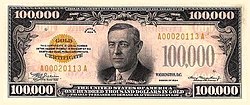
Considering that he is, in hindsight, seen as a somewhat weak president, Woodrow Wilson was an odd choice for the now-extinct $100,000 bill. I would expect a Washington, a Lincoln, perhaps one of the Roosevelts...but Wilson? Maybe because the heavy hitters of the presidential lineup graced other bills, the Treasury had to dip into the second tier of U.S. presidents/officials for the big notes.
If kids today were aware of any of this, I'm sure there'd be all kinds of jokes about dropping Wilsons, snorting white powdered substances out of Wilsons, etc.
For a possibly accurate crash course in other extinct cash, check out Wiki.
Wednesday, December 30, 2009
Europeans: Obama Bigger than Jesus - Jesus: It Didn't Work for John Lennon
So much to tackle, so little time. For now, I have only a tidbit: what useless, spineless, philosophically-windswept, gullible, short-sighted fools those Europeans are. Even the most liberal American newspapers would never openly say that Obama is greater than Jesus, though they constantly imply it with savior imagery.
Such hyperbolic nonsense is unsurprising, considering the source. Europe is still drinking the Obama Kool-Aid, even after popular opinion has turned against the President's liberal agenda. For Europeans, the hope that maybe, just maybe, America will follow the same culturally vapid, materialistic, quasi-socialist path as themselves is embodied in Obama's rise to power.
Such hyperbolic nonsense is unsurprising, considering the source. Europe is still drinking the Obama Kool-Aid, even after popular opinion has turned against the President's liberal agenda. For Europeans, the hope that maybe, just maybe, America will follow the same culturally vapid, materialistic, quasi-socialist path as themselves is embodied in Obama's rise to power.
Thursday, December 24, 2009
The Hijacking of Abraham Lincoln
I just finished reading Jay Winik's 2001 historical treatise April 1865: The Month That Saved America. Weaving together the chronology of the Civil War's fateful final month with background on the major players and events leading up to it, Winik's book provides both a comprehensive look at Civil War-era politics and an insightful commentary on how so many factors contributed to the conflict's end. It's a fantastic historical book, and I highly recommend that you purchase it. Amazon is hawking used copies for less than a dollar; you have no excuse not to buy it right now.
The book's appraisal of its central characters, including U.S. President Abraham Lincoln, Confederate President Jefferson Davis, and Generals Robert E. Lee and Ulysses S. Grant, is appreciably honest. Winik admires all of the above, without whitewashing any of them.
In particular, his writing got me thinking about the legacy of Abraham Lincoln as it relates to today's political situation. Perhaps only two or three other presidents in history are as beloved and remembered for greatness as Lincoln. A well-cited Wikipedia article on presidential polls sees Lincoln as one of three perennial "greatest presidents", with Washington and Franklin Roosevelt taking the other two slots. Interestingly, according to the 1982 Murray-Blessing poll, Lincoln is just as loved by both conservatives and liberals.
No wonder, than, that during the past election cycle Old Abe's name was cited time and time again by the stumpers of both parties, primarily in two ways:
1, the Republican Party continued to remind us that it is, in fact, "the party of Abraham Lincoln" (and Theodore Roosevelt and Ronald Reagan), and that Lincoln is one of the great conservative heroes.
2, the Democratic Party continued to both draw and welcome parallels between its nominee, then-Senator Barack Obama, and Lincoln, framing both men as outsiders from rude beginnings who promise to bring change and unite the nation during times of crisis.
Last year I did not think much of such parallels. If I did at all, I remember being vaguely suspicious of Obama-Lincoln comparisons. Obama has always struck me as more of an anointed partisan standard-bearer than Lincoln (who was not always on the best of terms with his own party). Similarly, I thought it odd that John McCain would drop Lincoln's name, knowing that the Glenn Beck-fed Libertarian-Republicans of today are generally appreciative of states rights, to the point of identifying with the very Confederacy that Lincoln waged war against.
Winik's unburnished portrayal of Lincoln has given me clarity. When it comes to Abraham Lincoln, both parties are wrong, and neither can claim that, in their current form, that Lincoln would be onboard with their agendas.
Foremost, Lincoln was essentially a federalist. Conservatives might like to drop Lincoln's name, but the fact is, the 12th president used his executive power do the very thing that they always complain about: he amassed federal power and literally forced the southern states back into line via the Civil War. Would a true, small-government, states-rights conservative ever support such a methodology? No way, as is evidenced by this work from the endlessly readable Harry Crocker.
Secondly, liberals ought to take note that Lincoln never intended to be the great healer of the American racial divide. A look at his comments on the subject prior to the Emancipation Proclamation are telling indeed. He was not driven by modern notions of political correctness and equality; primarily, he needed to imbue the dying Union war effort with a new sense of moral purpose. Look no further than his famed letter to Horace Greeley:
If I could save the Union without freeing any slave I would do it, and if I could save it by freeing all the slaves I would do it; and if I could save it by freeing some and leaving others alone I would also do that. What I do about slavery, and the colored race, I do because I believe it helps to save the Union; and what I forbear, I forbear because I do not believe it would help to save the Union
It would be unfair to say that Lincoln had a strictly utilitarian view towards abolition. His correspondence prior to the war, and during the early part of it, make clear the fact that he had sympathy towards the slaves and wanted to see slavery disappear as an American institution. Yet his efforts for the abolition of slavery and for general emancipation have to be seen in light of Lincoln's political savvy. He was not what liberal college professors would call a civil rights leader (as far as I can reason, the idea of freeing the blacks and segregating them, or sending them to Liberia, wouldn't qualify as an inspiring thing for a civil rights leader to suggest).
Therefore, in an ultimate sense Lincoln's legacy is not immediately relatable to either of today's political parties. He was neither conservative nor liberal as we define the two today. What was Lincoln, then?
He was magnanimous.
Today's political leaders enjoy defeating and punishing the opposition, shutting them out of the political process, blaming them, and marginalizing them. Obama, whose proponents always trumpet him with cornball monikers like "the president of change", "the bringer of the politics of transformation", etc, has done exactly this (look no further than the healthcare debate).
Lincoln did not. Lincoln reached not only across the aisle but across the battlefield, ensuring that a defeated Confederacy would not become a subjugated Confederacy. He exhorted the Union to accept the southern states' return with forgiveness, not brutality. Though he did not live to preside over the Reconstruction Era, he nevertheless impacted it by setting in motion a process of reconciliation, not retaliation.
I challenge you to name one politician today who can truly be called "magnanimous" in the Lincolnian sense. There are none. (In particular, the plethora of Democrats who continue to cite George W. Bush as the cause of all our current problems represent the opposite of Lincoln's approach.)
The next time you hear Lincoln's name on the campaign trail, be cognizant of the cheapness at hand. Some figures are too complex for the soundbyte age. The 16th president, in his glory and with his flaws, is a man not apt for comparison.
The book's appraisal of its central characters, including U.S. President Abraham Lincoln, Confederate President Jefferson Davis, and Generals Robert E. Lee and Ulysses S. Grant, is appreciably honest. Winik admires all of the above, without whitewashing any of them.
In particular, his writing got me thinking about the legacy of Abraham Lincoln as it relates to today's political situation. Perhaps only two or three other presidents in history are as beloved and remembered for greatness as Lincoln. A well-cited Wikipedia article on presidential polls sees Lincoln as one of three perennial "greatest presidents", with Washington and Franklin Roosevelt taking the other two slots. Interestingly, according to the 1982 Murray-Blessing poll, Lincoln is just as loved by both conservatives and liberals.
No wonder, than, that during the past election cycle Old Abe's name was cited time and time again by the stumpers of both parties, primarily in two ways:
1, the Republican Party continued to remind us that it is, in fact, "the party of Abraham Lincoln" (and Theodore Roosevelt and Ronald Reagan), and that Lincoln is one of the great conservative heroes.
2, the Democratic Party continued to both draw and welcome parallels between its nominee, then-Senator Barack Obama, and Lincoln, framing both men as outsiders from rude beginnings who promise to bring change and unite the nation during times of crisis.
Last year I did not think much of such parallels. If I did at all, I remember being vaguely suspicious of Obama-Lincoln comparisons. Obama has always struck me as more of an anointed partisan standard-bearer than Lincoln (who was not always on the best of terms with his own party). Similarly, I thought it odd that John McCain would drop Lincoln's name, knowing that the Glenn Beck-fed Libertarian-Republicans of today are generally appreciative of states rights, to the point of identifying with the very Confederacy that Lincoln waged war against.
Winik's unburnished portrayal of Lincoln has given me clarity. When it comes to Abraham Lincoln, both parties are wrong, and neither can claim that, in their current form, that Lincoln would be onboard with their agendas.
Foremost, Lincoln was essentially a federalist. Conservatives might like to drop Lincoln's name, but the fact is, the 12th president used his executive power do the very thing that they always complain about: he amassed federal power and literally forced the southern states back into line via the Civil War. Would a true, small-government, states-rights conservative ever support such a methodology? No way, as is evidenced by this work from the endlessly readable Harry Crocker.
Secondly, liberals ought to take note that Lincoln never intended to be the great healer of the American racial divide. A look at his comments on the subject prior to the Emancipation Proclamation are telling indeed. He was not driven by modern notions of political correctness and equality; primarily, he needed to imbue the dying Union war effort with a new sense of moral purpose. Look no further than his famed letter to Horace Greeley:
If I could save the Union without freeing any slave I would do it, and if I could save it by freeing all the slaves I would do it; and if I could save it by freeing some and leaving others alone I would also do that. What I do about slavery, and the colored race, I do because I believe it helps to save the Union; and what I forbear, I forbear because I do not believe it would help to save the Union
It would be unfair to say that Lincoln had a strictly utilitarian view towards abolition. His correspondence prior to the war, and during the early part of it, make clear the fact that he had sympathy towards the slaves and wanted to see slavery disappear as an American institution. Yet his efforts for the abolition of slavery and for general emancipation have to be seen in light of Lincoln's political savvy. He was not what liberal college professors would call a civil rights leader (as far as I can reason, the idea of freeing the blacks and segregating them, or sending them to Liberia, wouldn't qualify as an inspiring thing for a civil rights leader to suggest).
Therefore, in an ultimate sense Lincoln's legacy is not immediately relatable to either of today's political parties. He was neither conservative nor liberal as we define the two today. What was Lincoln, then?
He was magnanimous.
Today's political leaders enjoy defeating and punishing the opposition, shutting them out of the political process, blaming them, and marginalizing them. Obama, whose proponents always trumpet him with cornball monikers like "the president of change", "the bringer of the politics of transformation", etc, has done exactly this (look no further than the healthcare debate).
Lincoln did not. Lincoln reached not only across the aisle but across the battlefield, ensuring that a defeated Confederacy would not become a subjugated Confederacy. He exhorted the Union to accept the southern states' return with forgiveness, not brutality. Though he did not live to preside over the Reconstruction Era, he nevertheless impacted it by setting in motion a process of reconciliation, not retaliation.
I challenge you to name one politician today who can truly be called "magnanimous" in the Lincolnian sense. There are none. (In particular, the plethora of Democrats who continue to cite George W. Bush as the cause of all our current problems represent the opposite of Lincoln's approach.)
The next time you hear Lincoln's name on the campaign trail, be cognizant of the cheapness at hand. Some figures are too complex for the soundbyte age. The 16th president, in his glory and with his flaws, is a man not apt for comparison.
Subscribe to:
Posts (Atom)